
Think about the last time someone pushed you to buy.
They asked for the decision once, then again. They mentioned the price would change on Friday. You smiled, said you’d think it over, and had no intention of calling back.
You weren’t being difficult. You were protecting your choice.
Now flip the chair. Your prospects are doing the same thing to you, and they’re polite about it. If you’ve been searching for how to sell without being pushy, here’s what I want you to remember:
Pressure rarely makes people decide faster. It makes them protect their freedom to decide.
Want to read this article offline? Download a PDF here.
Why Does Pushing Harder Create Buyer Resistance?
Psychologists call it reactance. Brehm proposed reactance theory in 1966, and the core idea has held up for decades. People expect freedom in their choices, and when that freedom feels threatened, they push back to protect it.
In a sales conversation, the threatened freedom is simple. It’s the freedom to decide in their own time and in their own way, including the freedom to say no. High-pressure sales tactics attack it directly: repeated closes, artificial deadlines, and offers that disappear on Friday.
The old saying holds up: a person convinced against their will still holds the same opinion. Your buyer won’t argue with you. They’ll go quiet, stall, or tell you they’ll think about it. Silence is the polite version of resistance, and the signals are all there if you know where to look.
What Is Buyer Resistance Trying to Tell You?
A buyer who pulls back is still communicating. You can’t not communicate. Silence, delays, and suddenly short answers are all signals, and signals are intel.

Here’s how I’d read the most common ones:
- “Let me think about it” – Something doesn’t feel right yet. It may be trust, a missing piece of information, or a concern they haven’t voiced.
- The warm call that goes cold – You may have outrun their pace, or someone else needs a seat at the table.
- A sudden fixation on price – Sometimes it’s the price. Sometimes price is the safest objection to raise when the real concern is risk.
- Shorter answers, less engagement – They’re protecting their options.
Buying decisions rarely rest on logic alone. Another round of facts won’t fix a problem the facts didn’t cause. What closes that gap is trust, and here’s the principle I come back to every time:
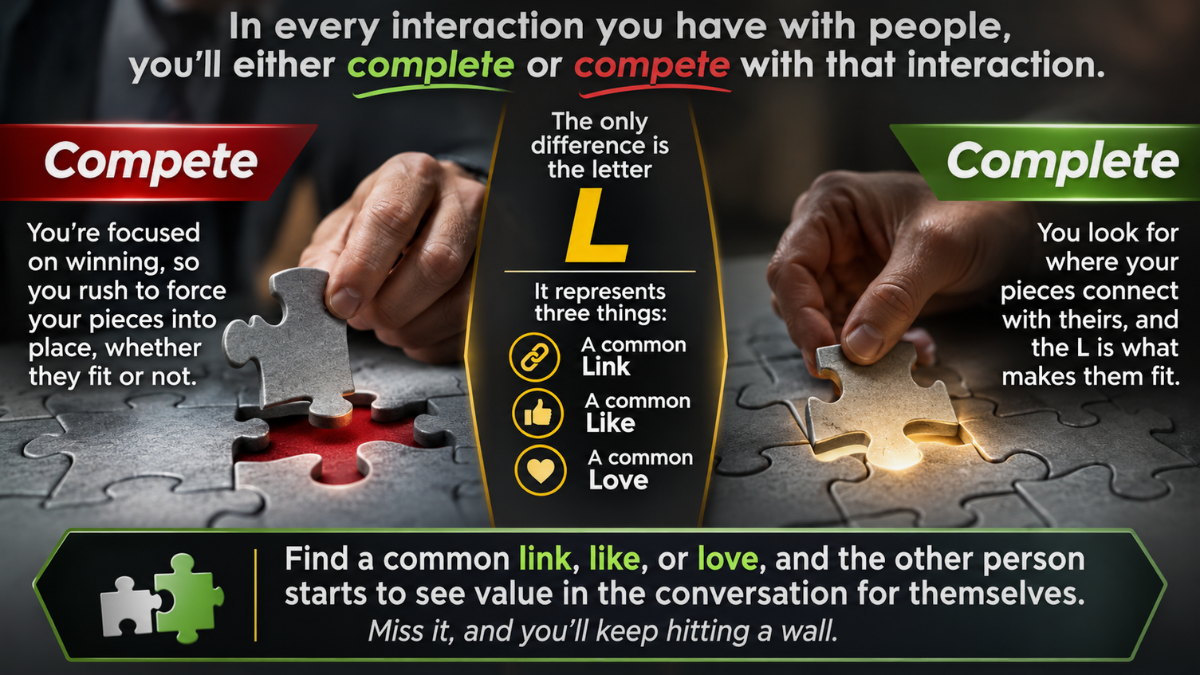
In every interaction you have with people, you’ll either complete or compete with that interaction.
Being French, my brain went somewhere unexpected with those two words. Compete and complete are almost identical. The only difference is the letter L. I think of that L as three things: a common link, a common like, or a common love.
Picture a conversation as a puzzle. When you compete, you’re focused on winning, so you rush to force your pieces into place, whether they fit or not. When you complete, you look for where your pieces connect with theirs, and that L is what makes them fit.
Find a common link, like, or love, and the other person starts to see value in the conversation for themselves. Miss it, and you’ll keep hitting a wall.
So, How Do You Sell Without Being Pushy?
Let’s be clear, “not pushy” doesn’t mean passive. A buyer who’s ready deserves a clear next step, and holding it back is avoidance.
Here’s how I define ethical persuasion: helping someone reach a decision they can stand behind, with the full picture and the freedom to say no.
I teach that influence starts with permission. You earn it by aligning your approach with how the buyer is wired, so they feel seen, understood, and supported. Your intent stays the same while your delivery adapts. That’s influence as service, and both sides win.
In a sales conversation, you rarely have the buyer’s DISC profile. You have what you can see and hear, and that’s enough to start.
If you use DISC for sales conversations, look for two clues:
- Pace – Are they fast or slow, outgoing or reserved? Listen to how quickly and how loudly they talk, and watch their body language.
- Priority – Are they focused on tasks and results, or on people and interaction?
Together, the two clues point you toward how to communicate: firm suits Direct, fun suits Inspiring, friendly suits Supportive, and factual suits Cautious.
When I’m unsure, I start friendly. (Nobody gets upset by friendly.) Then adjust as the pattern becomes clear.
Stop Pushing, Start Decoding
People remember how a decision was handled long after they’ve forgotten the terms, and that memory can shape whether they renew or refer you.
In the field, I learned a simple chain: a good question leads to a conversation, the conversation makes contact, and contact leads to a contract when you speak their language.

Decoding sharpens with practice. The more conversations you read, the sooner you can tell the difference between a buyer who needs another day and one who has already decided against you.
If you want to read your sales conversations with confidence, see how my DISC sales training works.
DISC Makes Everything Make Sense!